Last year, while many Ladysmith residents struggled with food insecurity, $20,000 worth of produce was rescued from backyards across the community by the Ladysmith Resources Centre Association’s (LRCA) Fruit Rescue program. It harvested 8,692 pounds of fruit and vegetables that would otherwise have gone to waste—a remarkable 30% increase from the program’s first year in 2023.
“The very first year we picked 5,722 pounds,” said Shannon Crowards, LRCA’s Food Security Outreach Worker who runs the program. “It grew in the next year, and then last year it was 8,692 pounds of fruit. It’s unbelievable.”
The program’s success lies in its simplicity: a three-way distribution model where homeowners, volunteers, and those facing food insecurity all benefit. After each harvest, one-third goes to the property owner, one-third is shared among volunteers, and the final third goes to the LRCA Food Pantry and partner organizations.
“A lot of the time volunteers will not take their whole third,” Crowards noted, “just whatever they want to use at home and everything else is distributed.” Similarly, many homeowners—often elderly residents overwhelmed by their productive gardens—decline their share entirely.
Speed is central to the program’s model. According to Crowards, produce is typically delivered to priority distribution points—including the Ladysmith Food Pantry, Stz’uminus First Nation, Ladysmith Family & Friends (LaFF), and Harvest House in Chemainus—within 24 hours of being picked, with distribution coordinated around each organization’s hours of operation.
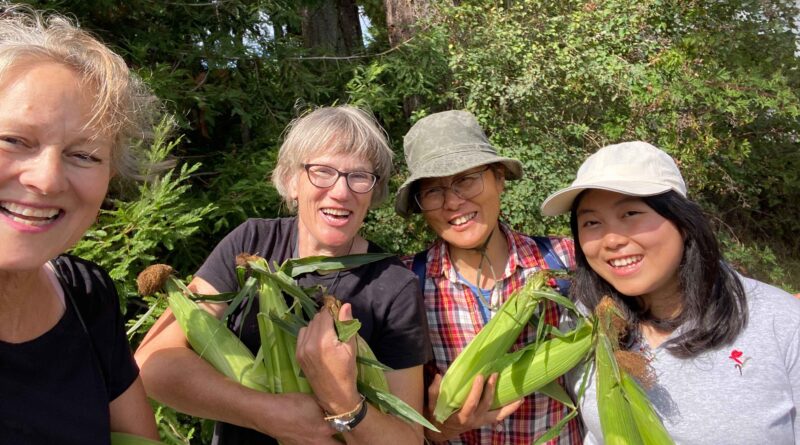
Any surplus that cannot be immediately absorbed is stored in commercial refrigerator spaces at the Heart on the Hill (the Ladysmith Resources Centre Association) or in cold storage donated by volunteers. For high-volume items, the team goes further: excess apples have been pressed into juice, and surplus sweetcorn has been shucked, boiled, and frozen for later use in LRCA programs.
Apples are by far the most common offering, reflecting the abundance of mature apple trees in Ladysmith’s residential neighbourhoods. For homeowners who can’t wait for a scheduled pickup—or simply prefer to drop things off themselves—the LRCA accepts direct drop-offs at their location for distribution through the food bank.
The program began in 2023 when LRCA received a grant as part of the CommUNITY Together to End Poverty-Hw-nuts’-ulwum (As One) Poverty Reduction Strategy. Before that, informal volunteers had been collecting fruit during COVID-19, but without structure or coordination. Crowards was hired to transform good intentions into sustainable impact.
Her first step was learning from others. She reached out to Nanaimo Community Gardens, where a coordinator “has been doing it for over 15 years, so she has a really sleek program,” Crowards said. The mentorship proved invaluable for understanding volunteer management, equipment needs, and distribution logistics.
Over three years, the program has grown from 37 picking events in 2023 to 56 fruit rescues in 2025, with volunteers contributing hundreds of hours of their time. All volunteers receive ladder safety training and work under LRCA insurance, providing reassurance to homeowners opening their private gardens to strangers.
Despite its success, many don’t know about the program. “The biggest challenge I’ve faced with the Fruit Rescue program has been getting the information and the publicity about it out into the community,” Crowards admitted. Many residents with fruit-heavy trees don’t know help is available, and potential volunteers remain unaware of the opportunity.
The program does have natuiral limits—the volume it can handle in any given season is constrained by volunteer availability, storage capacity, and the desirability of what’s being offered—making outreach all the more important to ensure resources are matched efficiently.
The program exists within a broader movement across Vancouver Island and beyond. Similar initiatives operate in Nanaimo, the Cowichan Valley, and communities throughout British Columbia, each adapting the model to local needs.
While programs elsewhere may charge fees—such as Nanaimo Community Gardens $25 volunteer membership—Ladysmith’s approach keeps everything free, relying on volunteers who “want to do it for being out in the community and helping in a program that is giving back.”
As fruit trees prepare for another growing season, Crowards and her team are ready to turn private surplus into community sustenance, one harvest at a time.
Ladysmith residents with fruit trees or gardens needing harvest can contact Shannon Crowards at shannon@lrca.ca or 250-245-3079. Homeowners who prefer to drop off produce directly can do so at the LRCA location for distribution through the food bank.
Those interested in volunteering can visit the LRCA website or contact volunteer coordinator Shirley Sloan through the same number. Volunteers must complete a short-form criminal records check and receive basic safety training, all coordinated through LRCA at no cost to participants. The Ladysmith Resources Centre Association is located at 630 2nd Avenue and is open Monday through Friday, 9 a.m. to 3 p.m.