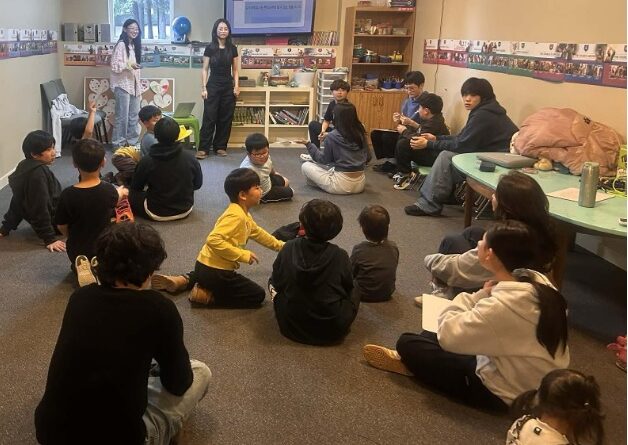
Nanaimo’s Woori Church, 4951 Rutherford Rd, started a new youth program to help younger generations build a stronger foundation in Korean culture and help Korean-Canadian children understand their identity while living among a diverse population on Vancouver Island.
The program currently serves 30 youth who want to learn Korean to preserve their heritage and help students maintain their language skills so they can communicate easily with their families and the broader Korean community. This language link is critical to bridging generational gaps in immigrant homes.
Mina Hong’s Master of Education thesis at the University of Victoria entitled Heritage Language Maintenance and Development Among Asian Immigrant Families in Canada found that when children started public school, they often switched quickly to speaking English. This made it more difficult for them to talk with their parents or grandparents, and sometimes lead to loss of identity and connection with their cultural community.
Many Asian parents also view bilingualism as a tangible economic advantage, believing that fluency in both English and Korean would lead to better career opportunities for their children.
Volunteer teacher Lee Uen He, currently working as a childcare educator, created the lessons after observing that many families were worried their children would lose their roots. “Parents wanted a space outside the home where Korean was the primary mode of communication, rather than just a secondary language used in passing,” He said.
He said the classes were interactive and focused on real conversations and useful words, not just memorization. The sessions were two hours every Sunday evening, so they did not interfere with regular school. The community offers these classes for free, covering costs with donations and church support.
The program does not give out certificates, but He measures progress by how well students discuss different topics, and share their feelings in Korean without switching to English. To practice these conversational skills, students gather in small-group “QT” (Quiet Time) sessions to relate activities of their daily lives, peer relationships, and current concerns. Over time, students became more confident and comfortable doing so.
Dohyun Park, 19, values the opportunity to discuss his personal relationships. “Learning the language helps me understand my parents better, and the sessions help me understand myself,” he added. He said that this “two-track” approach makes it feel like a place where all parts of his life fit together.
Julie Kwon, a parent whose children are in the program, has seen significant growth in her family since the program began. She mentioned how important it is to have a structured space where her children can explore their roots. “It is hard to teach these values only at home,” Kwon admitted.
“Seeing my children practice their Korean has been very rewarding,” Kwon continued. She noted that the program provides a vital community for families living in Nanaimo. “They aren’t just learning subjects; they are building a network of friends who have the same background.”
Pastor Seong Ho Lee, helps run the program and said, “When the youth share their ideas, they learn how to talk about their values.” He believes this practice, along with Korean lessons, gives them the confidence to lead others.
This program is part of a larger trend in British Columbia, which sees cultural groups helping minority youth. The Greater Vancouver Korean Language School started weekend classes in the 1970s, and since then, many churches have also offered programs to help kids learn Korean. These community spaces give young people a place to practice the language and connect with others who share their background. As more families joined from across the region the church grew to 100 members and the program now serves about 30 youth.
The push to maintain heritage languages also extends beyond local community halls and into the formal educational sphere. The British Columbia Ministry of Education recognized the importance of second languages, noting in its Grade 11 and 12 Korean curriculum that exploring diverse forms of cultural expression promoted a greater understanding of students’ own cultural identities. Under the provincial guidelines, language acquisition was viewed as a lifelong process. The curriculum expected students not only to exchange ideas and narrate stories, but also to analyze cultural points of view and navigate etiquette.
To further support this, public school districts across the province offer Language Challenge Exams. These standardized exams allowed fluent students to earn formal graduation credits for Grade 11 and 12 Korean, validating their community-based learning.
Vancouver Island’s efforts are part of a bigger conversation across Canada about multiculturalism and helping young people from immigrant families feel at home. Community classes give students the language skills they need to take part in Canadian society while staying connected to their heritage.