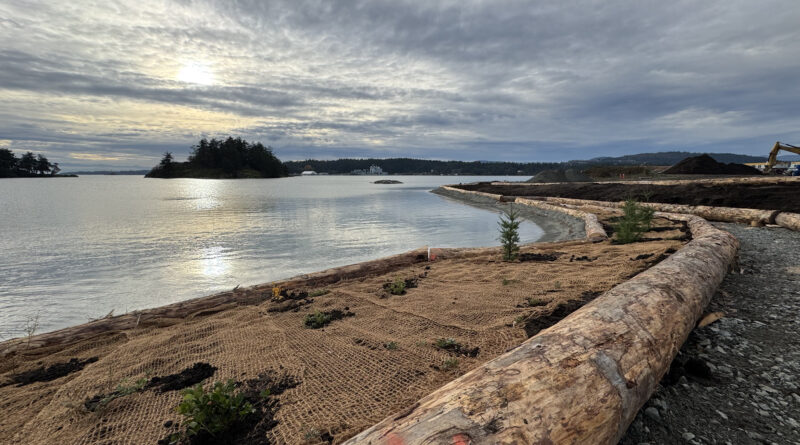
The Esquimalt and Songhees Nations have partnered with the Department of National Defense (DND) and Public Service and Procurement Canada (PSPC) to decontaminate a 400-metre stretch of coastline bordering Plumper Bay, northwest of Victoria. The project has removed approximately 16,000 cubic metres of contaminated material since June 2025, and is funded by the Federal Contaminated Sites Action Plan (FCSAP). The Project is expected to wrap up in October 2026.
The harbour was used for industrial activities such as log storage and plywood production in the 1900s, which left behind contaminated wood and metal waste. This has meant residents can’t swim in these waters, and marine and animal wildlife have left the area.
Esquimalt Harbour has been home to naval operations and an active industrial harbour for over 150 years. Decades of milling and log booming activity have resulted in wood waste deposits that produce toxins as they decompose, impacting the seafloor flora and fauna and creating inhospitable conditions for marine life in the harbour.
“Too much wood is actually not like a fertilizer,” said Rob Thomas, Senior Environmental Specialist for PSPC. “It’s actually a contaminant that causes harm to the benthic communities and the marine organisms.”
A benthic community is a collection of organisms living on, in, or near the bottom sediments of oceans, lakes, and streams. These organisms – worms, clams, and crustaceans – are critical for nutrient cycling, food webs, and ecosystem health.
Fresh sand and gravel replacing contaminated shoreline has yielded positive results. “Almost right away, we’re starting to see crabs on the new substrate,” said Thomas. He hopes to see full recolonization of the beach in the next five years. The project aims to restore the area, enhance biodiversity, and protect against erosion, using Traditional Knowledge to guide the process.
DND owns the property up to the high watermark, but beyond that belongs to the territories of the Songhees and Esquimalt Nations. DND has a mandate to reduce its environmental impact and will return access to the shoreline to these two Nations.
Taylor Reidlinger, the Marine Program Manager for the Esquimalt Nation, was involved in the design and planning phases of the project. Helping to communicate the ecological priorities between the nations’ leadership, community members, and the federal project teams. She also worked to ensure that the proper staff were engaged during the different stages of the project.
The project is part of broader reconciliation efforts to restore trust through collaboration with all parties at every stage of the project, from concept designs to the final conditions of the site.
Kirsten Richot, Manager Environmental Operations for PSPC, consulted the Nations to understand and respect their “Traditional Knowledge, and Traditional use of the bay,” including what kind of plant species would they like in the habitat.
Once the project is completed, Indigenous communities plan to exercise their rights to Plumper Bay beaches and use their Traditional and Cultural Knowledge to sustain it going forward. This means restoring and maintaining access to the shoreline for community members.
“By addressing pollution and contamination concerns in the harbour, we start to remove some of the barriers that Indigenous folks face when exercising their rights, accessing food, and having relationships to their territories,” Reidlinger said.
Reidiger hopes the project will highlight how important genuine relationships built on respect are while addressing the industrial practices of the past that harm both the environment and people.
The Plumper Bay project is currently on pause for the ceremonial longhouse season, with work slated to resume in May 2026. More information about the Plumper Bay Revitalization Project is available at Canada.ca